← All daily discoveries
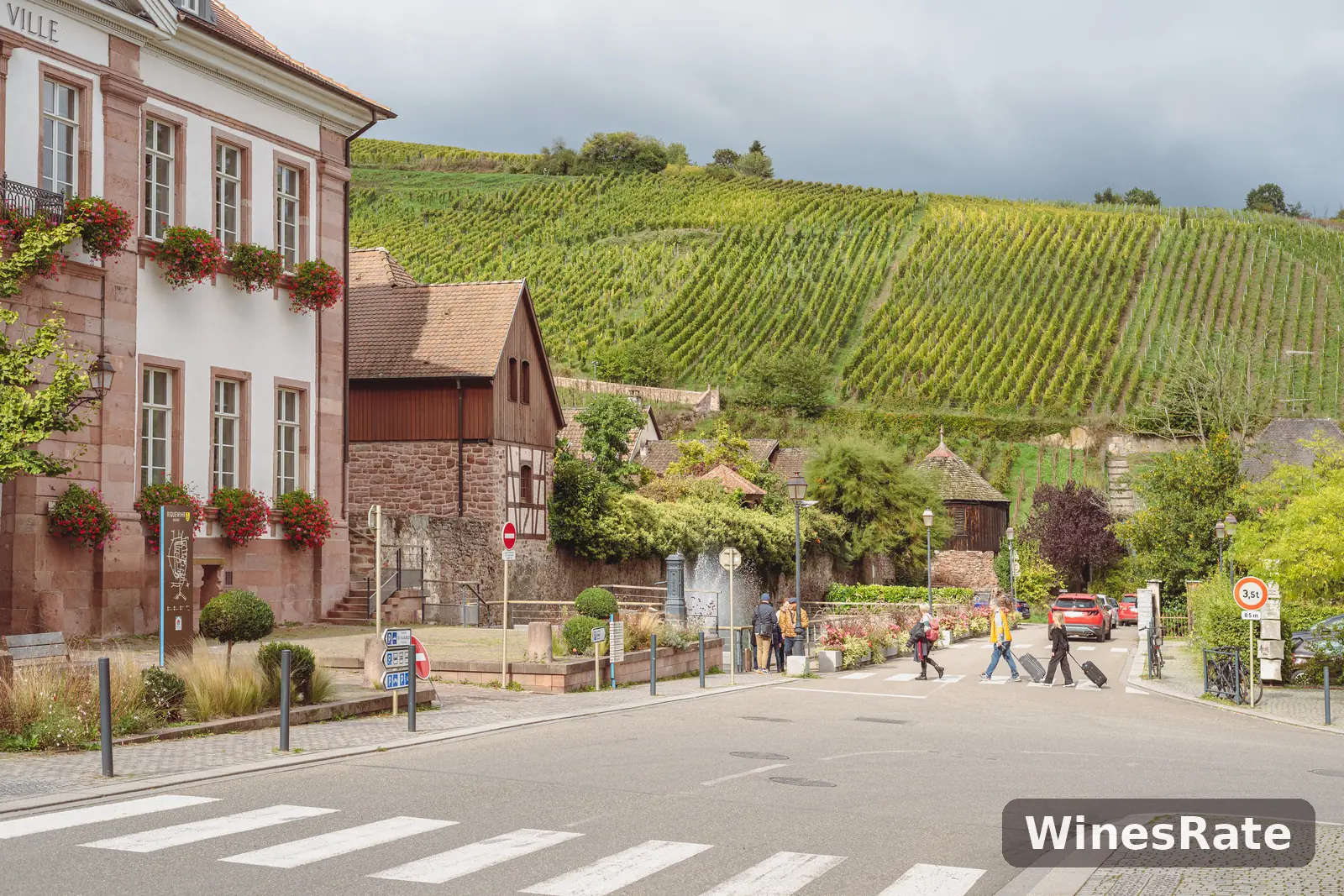
Vineyard rows north of Riquewihr in Alsace in autumn, with the village rooftops and the Vosges foothills beyond

WinesRate Guide

Alsace Wine Route: Villages, Tastings & How to Drive the Route des Vins

One hundred and seventy kilometres of vineyard road, seven grapes, fifty-one grands crus and more than seven hundred cellars — and a route you follow simply by watching for the brown road signs. Every fact below was checked against Alsace's own tourism agency and the growers' Route des Vins site on 28 November 2026.

170 km · Marlenheim–ThannInaugurated 1953Producers: 720+Grands crus: 51
Photo: Vineyard north of Riquewihr, by Flocci Nivis — CC BY 4.0, via Wikimedia Commons.
Marlenheim — northern start near Strasbourg →Riquewihr — the famous village mid-route →Colmar — mid-route stop old town →Thann — southern end 170 km

The short answer: how do you actually follow the route?

Follow the brown road signs that read “Route des Vins d'Alsace”. The route has no single road number: it strings together ordinary departmental roads through nearly 119 wine-producing communes, from Marlenheim in the north to Thann in the south, and the signs carry you from one village to the next. That is the whole navigation system — you do not need a satnav route number, and you should not try to plot one.

Allow three to four days to cover the whole 170 km without rushing, stopping in two or three villages a day. If you have only one day, the tourism agency's own advice is to focus on the four villages that do the most work: Ribeauvillé, Riquewihr, Kaysersberg and Eguisheim. More than 720 producers open their cellars to visitors along the way, so the limiting factor is never finding a tasting — it is choosing which ones to stop for.

170
kilometres
Marlenheim to Thann
119
communes
wine villages
720+
producers
open their cellars
3–4
days
to drive it all

One honest limit: tasting fees are not published on the route's official pages — each producer sets its own terms, and many small cellars have no fixed hours at all. This guide gives you the route, the grapes and the villages, and tells you to check with the producer before you go rather than quoting a price that does not exist.

The route in numbers

Verified against Alsace Voyage, the region's official tourism agency, on 28 November 2026. The route is the most emblematic wine itinerary in France, according to the growers' own Route des Vins site.

FigureWhat it isWhy it matters
170 km Length of the route, from Marlenheim (Bas-Rhin) to Thann (Haut-Rhin), at the foot of the Vosges. The whole route is a three- to four-day drive, not a day trip.
1953 The year the route was inaugurated. Inaugurated in 1953 — over seventy years of signposted cellars.
~119 communes Wine-producing communes the route passes through. Every few kilometres brings another village, another cellar door.
720+ producers Producers who welcome visitors to their cellars along the route. You will never struggle to find a tasting — the choice is the hard part.
51 grands crus Named terroirs, delimited between 1975 and 2007, each with its own appellation since 2011. The route's quality ladder: learn the names above the villages you stop in.
7 grapes Sylvaner, Pinot Blanc, Riesling, Muscat, Pinot Gris, Gewurztraminer and Pinot Noir. Almost all white — Pinot Noir is the only red grape on the route.
~50 trails Marked wine trails that let you walk between the rows of vines. The route is a walk as much as a drive — if you have the time.

⏱ The money fact: the route's official pages publish no tasting fees. Cellars set their own terms, and the growers' site and tourism agency give the route, the villages and the grapes — not prices. Check with each producer before you go, and never trust a fee quoted from an earlier year or a different region.

Why Alsace tastes like nowhere else

The region's own tourism agency explains the difference in four facts: the grapes, the crus, the sparkling wine and the villages themselves.

Grapes — seven, named on the label

Alsace wines are labelled by grape variety, not by village — the opposite of most of France. That makes the route unusually easy to navigate as a taster: if you like Riesling, you follow Riesling from cellar to cellar, and you can compare the same grape across a dozen terroirs in a single day. The seven are Sylvaner, Pinot Blanc, Riesling, Muscat, Pinot Gris, Gewurztraminer and Pinot Noir.

Grands crus — 51 named terroirs

Alsace has 51 grands crus, each a named terroir delimited between 1975 and 2007, with its own appellation since 2011. Only four grapes may carry a grand cru name — Riesling, Gewurztraminer, Pinot Gris and Muscat. When you see a grand cru name on a bottle, it is a place, not a brand: the slope above the village you are standing in.

Crémant — sparkling since 1976

Crémant d'Alsace, the region's sparkling wine, received its appellation in 1976. It is made by the traditional method and is the route's everyday celebration wine — the bottle to open at lunch, and the one most visitors end up taking home by the case. Ask for it at any cellar; every producer seems to make one.

Late harvest — since 1984

The designations “vendanges tardives” (late harvest) and “sélection de grains nobles” (selection of noble berries) were created in 1984 for wines made from overripe grapes. They are the route's sweet wines — rich, honeyed and long-lived — and the ones to ask about in the autumn, when the harvest is in.

What to taste: the seven grapes, in order

Taste in this order and the route teaches itself: from the lightest wines to the richest, finishing with the only red.

RieslingThe signature

Start with Riesling — dry, precise, electric

Riesling is the grape Alsace is known for, and the one to taste first while your palate is fresh. Alsace Riesling is dry — a surprise to anyone who knows the grape from Germany — with high acidity, citrus and stone fruit, and a mineral edge from the Vosges foothills. Taste it in Ribeauvillé, and ask for a grand cru bottling to see what the slope adds.

GewurztraminerThe aromatic

Then Gewurztraminer — the wine you smell before you taste

Gewurztraminer is Alsace's most aromatic grape: lychee, rose and spice, full-bodied and unmistakable. It is the wine that divides a room — people either love it at first sip or need a second glass — and it is the classic partner for the region's spiced food. Taste it in Turckheim and Eguisheim.

Pinot GrisThe rich one

Pinot Gris — rich, smoky, generous

Pinot Gris in Alsace is a full, rich wine, nothing like the light Pinot Grigio of Italy. It is the grape for the region's richer dishes, and the one that ages most gracefully of the three great whites. Taste it alongside Gewurztraminer at the same cellar and the difference between “aromatic” and “rich” becomes obvious in a single flight.

The othersEveryday glasses

Sylvaner, Pinot Blanc and Muscat — the route's everyday wines

Sylvaner is the light, fresh, everyday white of the route — the glass with lunch. Pinot Blanc is soft and apple-fresh, the house white of many cellars. Muscat is dry and grapey, a small-volume curiosity that most visitors have never tasted dry. These three are the wines the winemakers drink themselves, and the ones to buy by the case.

Pinot NoirThe only red

Finish with Pinot Noir — and a glass of Crémant

Pinot Noir is the route's only red grape, and Alsace makes it light, fresh and cherry-bright rather than heavy. It is a small share of production, which makes finding a good one feel like a discovery. And before you leave any cellar, ask for the Crémant d'Alsace — the traditional-method sparkling wine that has carried its appellation since 1976, and the best-value bottle on the whole route.

A three-day drive, north to south

The tourism agency's own pacing: three to four days for the whole route, two or three villages a day. Base in Colmar for the middle stretch — the natural hub for the southern half of the route.

Day 1Marlenheim–Obernai

The northern half — quiet villages, first tastings

Start at Marlenheim, west of Strasbourg, and drive south through the northern villages to Obernai. This is the quieter half of the route: fewer tour buses, smaller cellars, and the first grand cru slopes. Stop in Barr and Mittelbergheim on the way — two villages the agency names on the busy stretch — and taste Sylvaner and Pinot Blanc, the northern grapes at their freshest.

Day 2Obernai–Riquewihr

The famous stretch — Ribeauvillé to Riquewihr

From Obernai, drive through Dambach-la-Ville to Ribeauvillé, then to Hunawihr and Riquewihr — the village in the photograph at the top of this page, its main street running between pale, half-timbered houses. Taste Riesling in Ribeauvillé and Gewurztraminer in Riquewihr, and walk one of the marked wine trails between the rows.

Day 3Riquewihr–Thann

Colmar, Eguisheim and the southern end

From Riquewihr, continue to Kaysersberg — the agency's fourth one-day village — then Colmar for lunch and a proper look around. In the afternoon, drive the short hop to Eguisheim, and on through Turckheim and Rouffach to Thann, the southern end of the route. If you only have one day, this is the day: Riquewihr, Kaysersberg, Colmar and Eguisheim in a single loop.

No car?Train + bike

Doing the route without a car

Come by train to Colmar, Sélestat or Obernai — the agency's own advice — and base yourself in one of them. The vineyard bike route follows the same path for about 170 km, and around fifty marked wine trails let you walk between the vines from the villages themselves. If you are tasting, the agency is blunt: designate a driver, or come by train. A bike and a train ticket are the honest way to taste and still get home.

Costs & getting there: practical answers

Everything below is from the region's tourism agency and the growers' Route des Vins site, checked 28 November 2026.

🎟 Costs & when to go

  • Tastings: no fees are published on the official pages — each producer sets its own terms. Check with the cellar before you go.
  • Best months: May to October for walks in the vineyards; September and October for the harvest atmosphere.
  • Harvest: late August to October depending on the year. Respect the closures posted at vineyard entrances during harvest.
  • December: many winegrowing villages hold a Christmas market — the route's winter face, with mulled wine and spiced treats.
  • How long: three to four days for the whole route; one day is enough for Ribeauvillé, Riquewihr, Kaysersberg and Eguisheim.
  • Walking: about fifty marked wine trails cross the vineyard, each lined with information panels on the winegrower's work, the terroirs and the grapes.

📍 Getting there & around

  • By train: come by train to Colmar, Sélestat or Obernai — the three stations the tourism agency names — then use local buses, bikes or a car for the villages.
  • By car: follow the brown “Route des Vins d'Alsace” signs from village to village; there is no single route number to enter in a satnav.
  • By bike: the vineyard bike route follows the same path for about 170 km, from Marlenheim to Thann.
  • Base towns: Colmar is the wine capital and the natural base for the southern half; Obernai suits the northern half.
  • Designated driver: the agency's own advice — if you are tasting, designate a driver or come by train.
  • While you're there: the photograph at the top of this page is a vineyard north of Riquewihr, seen from the Avenue Méquillet.

Keep planning with WinesRate

Before you go, browse the regions you'll be tasting: start from the WinesRate homepage, explore wine regions — 190 regions across 17 countries, catch up in the WinesRate Journal, and check what white wines cost back home in our white wines under $30 list. WinesRate doesn't sell alcohol and publishes no ratings or scores — just real prices from real stores.

Frequently asked questions

The questions readers ask about the Alsace Wine Route, answered from the verified details above.

How long is the Alsace Wine Route?

About 170 km (106 miles), from Marlenheim in the north (Bas-Rhin) to Thann in the south (Haut-Rhin), at the foot of the Vosges. It was inaugurated in 1953 and passes through nearly 119 wine-producing communes.

How many days does it take to drive the Alsace Wine Route?

Three to four days will let you cover the whole route, with visits to villages and cellars, stopping in two or three villages a day. If you only have one day, focus on Ribeauvillé, Riquewihr, Kaysersberg and Eguisheim — the four villages the tourism agency itself recommends for a single day.

What grape varieties are grown in Alsace?

Seven main varieties: Sylvaner, Pinot Blanc, Riesling, Muscat, Pinot Gris, Gewurztraminer and Pinot Noir — the only red grape. Alsace wines are labelled by grape variety, so you can follow a single grape from cellar to cellar. Crémant d'Alsace is the region's sparkling wine, with its appellation since 1976.

How many grands crus are there in Alsace?

51. Each one corresponds to a terroir delimited between 1975 and 2007 and has had its own appellation since 2011. Only four grapes may carry a grand cru name: Riesling, Gewurztraminer, Pinot Gris and Muscat.

When is the best time to visit the Alsace Wine Route?

From May to October for walks in the vineyards, and in September and October for the atmosphere of the harvest — which runs from late August to October depending on the year. In December, many winegrowing villages hold a Christmas market. The route is a year-round drive, but the vines are at their best from late spring to the harvest.

Can I do the Alsace Wine Route without a car?

Yes. Come by train to Colmar, Sélestat or Obernai, the three stations the tourism agency names, and base yourself in one of them. A vineyard bike route follows the same path for about 170 km, and around fifty marked wine trails let you walk between the vines from the villages. If you are tasting, the agency's advice is to designate a driver or come by train.

Sources & how this page was made

Checked on 28 November 2026 against the official sources below:

  • Alsace Voyage — “The Wine Route of Alsace” (alsacevoyage.com/en/theme/vineyards/): 170 km from Marlenheim to Thann, inaugurated 1953, nearly 119 communes, 720+ producers, 51 grands crus (delimited 1975–2007, own appellation since 2011), seven grape varieties, Crémant d'Alsace appellation 1976, vendanges tardives and sélection de grains nobles created 1984, busiest stretch Obernai–Colmar, three to four days, one-day focus villages, best months May–October, harvest late August–October, December Christmas markets, ~50 wine trails, ~170 km bike route, train to Colmar, Sélestat or Obernai, designate a driver.
  • Route des Vins d'Alsace — official growers' site (routedesvins.alsace): the route as France's most emblematic wine itinerary, running north to south through the vineyards, with cycling routes and stay planning; the Vignobles & Découvertes label for member cellars.
  • WinesRate (winesrate.com): homepage, Regions, Journal and Best White Wines Under $30 pages — linked in “Keep planning” above and verified live on 26 November 2026.

The topic came from current social and trade conversation about European wine regions to visit. This page is original WinesRate content: every word was written for WinesRate, all facts were re-verified from the official sources above, and no text, image or video was copied from any post or creator. The only photograph used is the CC BY 4.0 Wikimedia Commons image credited in the hero. WinesRate does not sell alcohol and publishes no ratings or scores.

This guide lives at winesrate.com/discover/alsace-wine-route/ · Prepared 28 November 2026.