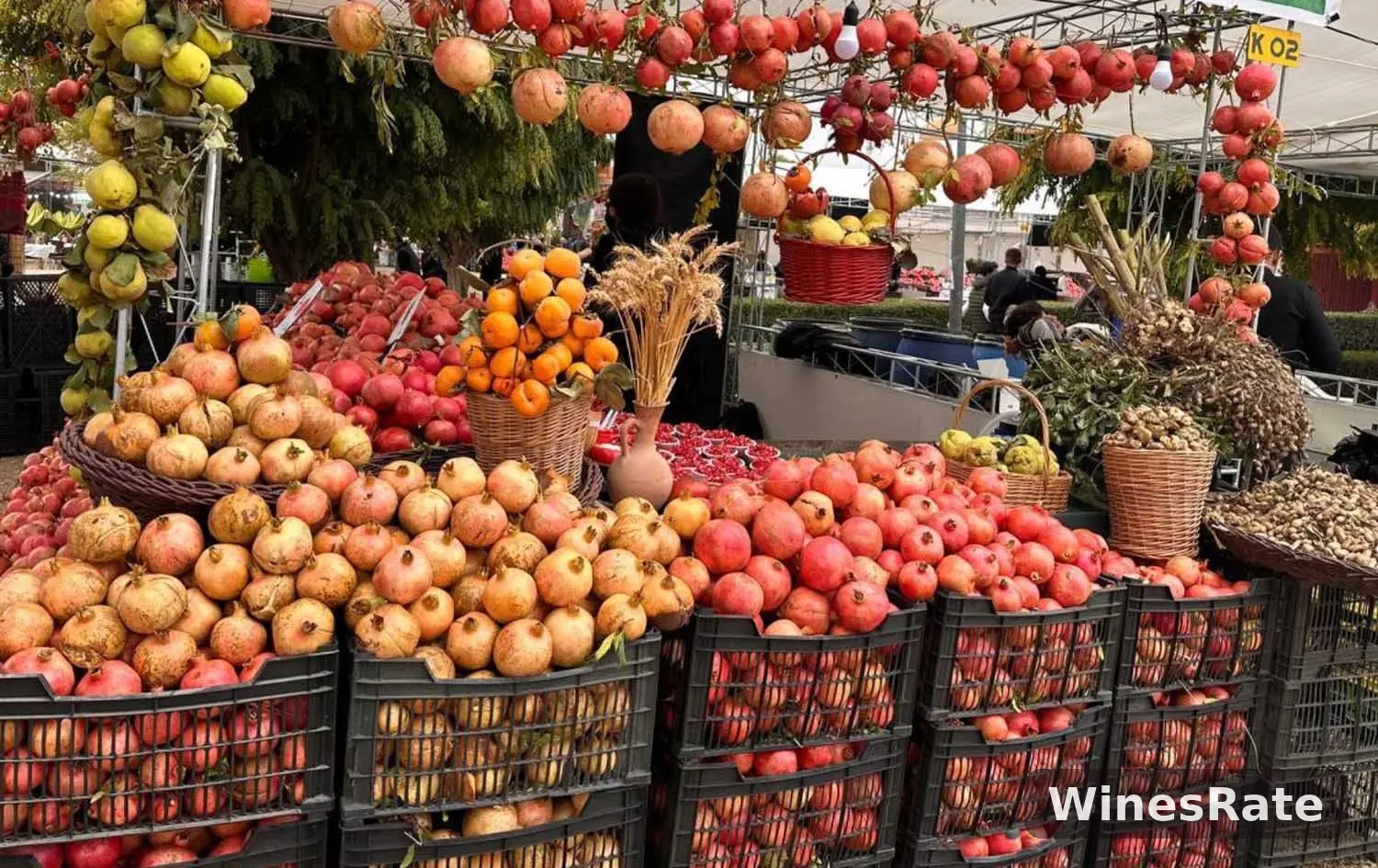
The short answer: what is this festival?
It is a harvest fair, not a wine festival — and that is exactly its charm. The Halabja Pomegranate and Autumn Festival, held each year in late October or early November at Halabja Amusement Park, is where the orchard villages of the Halabja mountains sell their crop directly: fresh pomegranates by the kilo and the box, juice pressed in front of you, and thick, dark pomegranate molasses — the sour-sweet backbone of Kurdish cooking. Established in 2013, it has grown into one of the largest agricultural fairs in Iraq, drawing hundreds of thousands of visitors over its run. Entry is free; bring cash in Iraqi dinars.
For drinks lovers, the draw is the juice and the molasses: the same fruit that goes into pomegranate wines elsewhere in the region is here celebrated fresh, pressed and concentrated — a harvest festival in its oldest form.
A festival built by orchard villages
Why a town in the Zagros foothills became famous for a fruit.
Halabja sits about 700 metres up in the Zagros foothills, with 700 to 900 millimetres of rain a year and the Sirwan river watering its orchards — country that has grown pomegranates for generations. The fruit is not a sideline here; it shapes the local economy, the kitchen and the town's identity. In 2013, local farmers and community organisers gave the harvest a public stage, and the Pomegranate and Autumn Festival has been held every year since.
The structure is simple and stays close to the farm. Growers from more than 150 villages bring their best fruit down from the mountains and stack it in crates along the aisles, slicing pomegranates open so visitors can taste before they buy. There is friendly competition in it — farmers informally vie for the finest and largest fruit — and the buying is serious: people arrive from across Kurdistan and from as far away as Basra in southern Iraq, and leave with boxes.
The scale, in the most recent reported figures, is remarkable for a town festival. The 2025 edition drew more than 419,700 visitors and around 700 booths, and reported sales of fruit, food and handicrafts passed 1.7 billion Iraqi dinars — roughly US$1.3 million — money that goes directly to growers, cooks and craftspeople rather than to an exhibition company. Local authorities mark the opening with a regional holiday, which turns the first day into a long-weekend outing for families across the region.
What to taste & buy
Three zones: fresh produce, women's handicrafts, and traditional Kurdish cuisine.
Fresh pomegranates. The main event. Different varieties are displayed side by side, sold by the kilo or by the box, and cut open for sampling on the spot. If you only buy one thing, buy fruit here — this is the harvest itself, at the source, in its week.
Fresh-pressed juice. Vivid, tannic and refreshing, pressed in front of you and sold by the glass. Pomegranate juice is the festival's signature drink: sharp enough to cut through a rich lunch, and about as far from a carton as juice gets.
Pomegranate molasses. The thick, dark syrup — known locally as rûbar, or dûshawa anar — being stirred in large vats is the festival's other star. It is the souring agent that gives Kurdish dishes their signature tang, and a jar travels home far more easily than a crate of fruit. Syrups, jams and dried arils sit alongside it on the pantry stalls.
The rest of the autumn harvest. Around 250 stalls sell fresh autumn crops and homemade goods beyond the pomegranate: olives, grains, dried crops and preserves. A second zone is given to women's handicrafts, and a third to traditional Kurdish cuisine — grilled meats, rice dishes and stews, many of them using pomegranate exactly the way the molasses-makers intend.
Music, dance & the social side
A harvest fair that doubles as the region's autumn reunion.
Commerce is only half of it. Live Kurdish music and traditional dance run through the days, and circles of the halparke — the traditional chain dance, also called govend — form spontaneously in the open pathways between stalls. Visitors come in colourful traditional dress, families picnic on the grass, and the festival functions as a social anchor for the region: a place to meet, reconnect and celebrate the season turning.
One respectful note for first-time visitors: Halabja is also the town that suffered the 1988 chemical attack, and its Peace Monument draws more than 100,000 visitors a year. Many festival visitors combine the trip with a quiet visit to the memorial, and the town appreciates both sides of why people come.
Planning a visit
Dates, hours, money and the Sulaymaniyah base — the practical answers.
When to go. The festival runs three to four days in late October or early November; the 2026 edition ran 28–31 October. Exact dates are confirmed each autumn by the Halabja Governorate, so treat late October as the planning window and confirm before booking. Gates have opened at 8:00 AM and closed at 6:00 PM in recent editions — arriving between 8:30 and 10:00 AM avoids the heaviest traffic and gets you parking near the park.
Where to stay. Hotels in Halabja fill up weeks before opening day. Most travellers stay in Sulaymaniyah, roughly 75 to 80 kilometres northwest, and visit the festival as a day trip — the standard pattern, and the one this guide recommends.
Money. Entry is free, but everything inside is cash in Iraqi dinars; stalls do not take cards. Change money before you leave Sulaymaniyah.
Checkpoints. Travel across the Kurdistan Region involves internal security checkpoints. Keep your passport and valid visa accessible in the vehicle, and allow extra time on festival mornings when the Halabja road is at its busiest.
Make a day of the mountains. A large share of festival visitors pair the fair with drives into the surrounding Hawraman countryside — orchards, mountain villages and the same landscape the fruit came from. It turns a market visit into a full autumn day in Kurdistan.
Keep planning with WinesRate
Festivals are where drinks culture starts — in the orchard, not the bottle shop. Browse the regions behind the world's drinks from the WinesRate homepage, explore wine regions — 190 regions across 17 countries, catch up in the WinesRate Journal, and check what bottles cost back home in our wine retail price reports. WinesRate doesn't sell alcohol and publishes no ratings or scores — just real prices from real stores.
Frequently asked questions
The questions readers ask about the Halabja Pomegranate Festival, answered from the verified details above.
When is the Halabja Pomegranate Festival?
Every year in late October or early November, during the pomegranate harvest. The festival usually runs three days, and the 2026 edition ran from 28 to 31 October. Exact dates are confirmed each autumn by the Halabja Governorate, so check the organisers' channels before booking travel for the next edition.
Where is the festival held, and what are the opening hours?
At Halabja Amusement Park in Halabja, in the Kurdistan Region of Iraq, about 75 to 80 kilometres southeast of Sulaymaniyah. Recent editions have opened daily from 8:00 AM to 6:00 PM, and arriving in the morning is the easiest way to beat the midday crowds and traffic.
Is entry free, and how do you pay for things?
Entry to the festival is free. Inside, bring cash in Iraqi dinars: the stalls are run by farmers, family producers and cooks, and card payment is not accepted. Pomegranates are sold by the kilo or by the box, and juice, molasses and preserves are priced at the stall.
What can you eat, drink and buy at the festival?
Fresh pomegranates from more than 150 villages, juice pressed in front of you, pomegranate molasses (rûbar), syrups, jams and dried arils, plus olives, grains and other autumn produce, women's handicrafts in their own zone, and traditional Kurdish cooking — much of it using pomegranate as the souring note. This is a family harvest fair built around fruit, juice and food rather than alcohol.
How do you get to Halabja, and where do you stay?
Most visitors base themselves in Sulaymaniyah and visit Halabja as a day trip — the drive is roughly 75 to 80 kilometres. Hotels in Halabja itself fill up well before the festival, which is another reason the Sulaymaniyah base is popular. Travel inside the Kurdistan Region involves internal checkpoints, so keep your passport and visa accessible in the vehicle.
How big is the festival?
It is one of the largest agricultural fairs in Iraq. The 2025 edition drew more than 419,700 visitors and around 700 booths, with reported sales of fruit, food and handicrafts above 1.7 billion Iraqi dinars — roughly US$1.3 million — according to figures reported by Shafaq News. The festival was established in 2013 and has grown every year since.
Sources & how this page was made
Festival details were checked on 27 November 2026 against published sources:
- Visit Iraq — “Guide to the Halabja Pomegranate and Autumn Festival in Iraqi Kurdistan” (visit-iraq.com): festival established 2013, Halabja Amusement Park venue, 8:00 AM–6:00 PM hours, three-zone layout and stall counts (reporting Rudaw), Sulaymaniyah distance and day-trip pattern, cash-in-dinars and checkpoint advice.
- Iraq Tourism — “Iraq in October: Autumn Weather, Festivals and Tips” (iraqtourism.org, updated November 2026): the 2026 edition's dates (28–31 October, from the KRG calendar), and the 2025 edition's figures — more than 419,700 visitors, 700 booths and over 1.7 billion dinars in sales — as reported by Shafaq News; Halabja's altitude, rainfall and the Sirwan river orchards; the Peace Monument's visitor numbers.
- Tripal — Halabja Pomegranate Festival listing (tripal.krd): annual three-day format during the autumn harvest, free entry, programme of music, dance and folkloric performance.
- Visit Kurdistan — Halabja Pomegranate Festival (visitkurdistan.com): the products of the festival — fresh fruit by the crate and kilo, juice pressed on the spot, molasses (rûbar / dûshawa anar), syrups, jams and dried arils.
- WinesRate (winesrate.com): homepage, Regions, Journal and Market Reports pages — linked in “Keep planning” above and verified live on 27 November 2026.
The topic came from a festival video shared with WinesRate from Facebook — footage of the 2026 festival's stalls of pomegranates, fresh juice and molasses vats. This page is original WinesRate content: every word was written for WinesRate, all facts were re-verified from the sources above, and no text, image or video was copied from any post or creator. The only photograph used is the CC0 Wikimedia Commons image credited in the hero. WinesRate does not sell alcohol and publishes no ratings or scores.
This guide lives at winesrate.com/discover/halabja-pomegranate-festival/ · Prepared 27 November 2026.